
On July 1, 2026, Tennessee’s statewide kratom ban took effect. The law, known as Matthew Davenport’s Law, was signed by Governor Bill Lee this spring after years of advocacy by families who lost loved ones to kratom and its concentrated derivatives. It prohibits the sale and possession of kratom in all its forms; leaf, powder, capsules, extracts, and the highly potent compound 7-hydroxymitragynine (7-OH).
That was a hard-won victory. It also took a very long time. Kratom sat on gas station and vape shop shelves in Tennessee for years; marketed as an herbal supplement, sold next to the energy shots, before the state acted.
Here is what should concern every parent, retailer, and official in Warren County: it took years to get kratom off the shelves. It took a matter of weeks for something new to appear in its place.
What we’re seeing in McMinnville
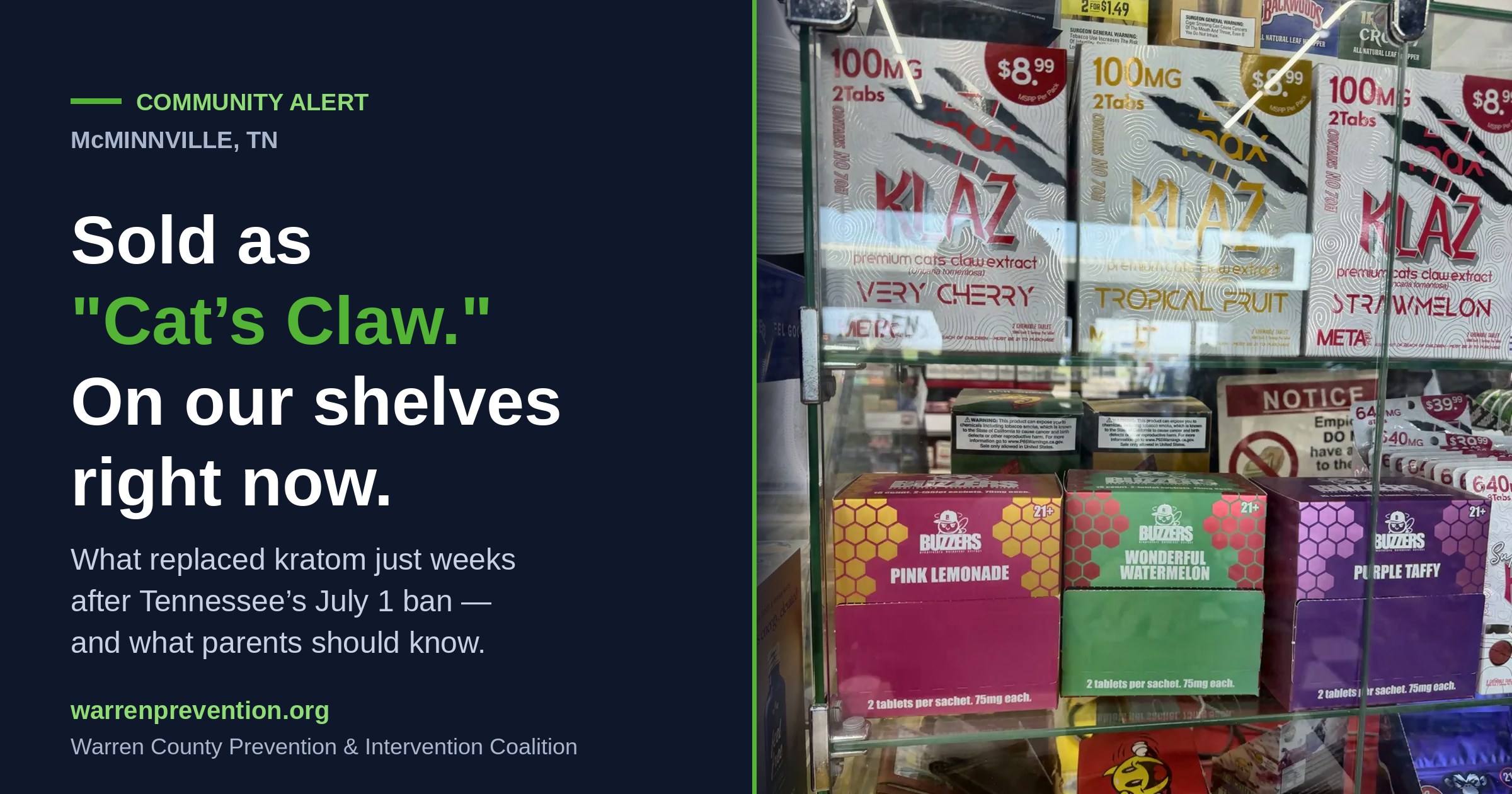
Within weeks of the July 1 ban, coalition members began noticing new products in stores in McMinnville and surrounding areas: chewable tablets sold under the names Buzzers and KLAZ, both labeled as “Cat’s Claw Extract.”

Cat’s claw (Uncaria tomentosa) is a woody vine from the Amazon. The genuine article is a mild herbal supplement, traditionally sold in health food stores for joint pain and immune support. It is not psychoactive. It does not produce anything resembling the opioid-like effect that kratom users seek. There is no reason a legitimate cat’s claw supplement would be sold as a flavored chewable tablet at a smoke shop register — in the exact spot where kratom used to sit.
What testing found in other states
We cannot tell you what is inside the products on local shelves, because to our knowledge no one in Tennessee has tested them yet. But we can tell you what happened when another state did.
On July 30, the Utah Department of Agriculture and Food and the Utah Poison Control Center issued a public warning about Buzzers Cat’s Claw tablets — the same brand name now appearing in our area. State lab testing found the tablets contained mitragynine pseudoindoxyl and MGM-15, two opioid-active compounds derived from the kratom plant. Both are Schedule I controlled substances in Utah. The products were linked to one death and multiple severe overdoses. Utah’s poison control director noted that in a matter of weeks, these “cat’s claw” products had grown to account for roughly one in five of the center’s kratom-related cases in 2026.
Days later, California Poison Control issued its own statewide warning naming two brands, Buzzers and Homiez, and cautioned that the compounds involved can be many times more potent than morphine.
In plain terms: in Utah, “cat’s claw” wasn’t an herbal supplement. It was a kratom-derived opioid wearing an herbal supplement’s label.
We want to be careful and fair here. We have not lab-tested the products sold locally, and we are not claiming that any specific store in Warren County is knowingly selling a controlled substance, many retailers may have no idea what’s actually in the products their distributors send them. But when a product with the same brand name has been lab-confirmed in another state to contain opioid-active kratom derivatives and linked to a death, “wait and see” is not an acceptable posture.
The pattern we keep repeating
Step back, and the sequence is depressingly familiar. A substance shows up on shelves in a legal gray zone. It spreads for years while evidence of harm accumulates. Families are devastated. Eventually, after enormous effort, lawmakers name that specific substance in a statute and ban it. And within weeks, distributors rotate in a replacement, a related compound, a chemical cousin, or in this case, the same class of compounds sold under a different plant’s name that no statute mentions.

We saw it with synthetic cannabinoids (“Spice”) a decade ago. We saw it with tianeptine (“gas station heroin”). We’re watching it happen now with kratom. The banned-substance list will always lag behind the product catalog, because a law names what exists today and a distributor can invent a new label by next month.
That’s not an argument against Matthew Davenport’s Law, it’s an argument that a ban-one-name-at-a-time approach can’t be the whole strategy.
The conversation we want to start
This coalition doesn’t have all the answers, and this article is not a policy demand. It’s an invitation; to parents, retailers, law enforcement, health providers, and our state and local officials, to help answer a harder question: how does Warren County get ahead of the next substance instead of reacting to the last one?
Should Tennessee’s drug statutes cover the compound class, not just the name? Utah could act on these products quickly because kratom’s opioid-active alkaloids and derivatives are scheduled there as a class. When a law bans “kratom” and a product shows up labeled “cat’s claw,” enforcement shouldn’t have to start from zero.
Who tests suspicious products here, and how fast? Utah’s Department of Agriculture tested Buzzers within weeks of the overdose reports. What’s the pathway in Tennessee for a coalition, a parent, or a police department to get a suspicious retail product lab-tested, and can that pathway move at the speed these products do?
Can we work with retailers before there’s a tragedy? Most local store owners don’t want to sell a mislabeled opioid to their neighbors. A voluntary retailer agreement, knowing your distributor, asking for certificates of analysis, declining unbranded “botanical” products that arrive right after a ban, could take these products off shelves faster than any statute.
Do clerks and parents know what to look for? A grape-flavored chewable tablet marketed as a “botanical extract,” sold at the register where kratom used to be, is a red flag. Awareness is the cheapest prevention tool we have.
Should there be a standing early-warning channel? Utah’s poison control data flagged the problem within weeks. Warren County has eyes in every store, school, and clinic — what we’ve lacked is a routine way to connect what people notice to the agencies that can act.
What you can do right now

If you or someone you know has purchased Buzzers or KLAZ “cat’s claw” products locally, do not consume them. If someone becomes ill after taking one of these products, call the Tennessee Poison Center at 1-800-222-1222, or 911 in an emergency, and tell them exactly what product was taken, because it may not contain what the label says.
If you’ve used kratom or these replacement products regularly and are struggling to stop, you are not alone, Tennessee recovery groups have reported an influx of people seeking help since the ban took effect, and stopping opioid-active substances abruptly can involve real withdrawal. Reach out to the coalition or the Tennessee REDLINE at 1-800-889-9789 for confidential, free referrals.
If you’re a retailer and these products are on your shelves, we’d genuinely rather talk with you than about you. Contact us at info@warrenprevention.org.
And if you’ve seen these or similar products in stores in Warren County, let us know. Every report helps us understand how widespread this is, and helps us make the case for acting before the next family pays the price for the gap between a distributor’s catalog and a statute’s wording.
Kratom was around a long time before Tennessee banned it. Its replacements needed only weeks. The question in front of our community is whether we’re willing to keep running that race from behind.
The Warren County Prevention and Intervention Coalition works to prevent substance misuse in Warren County, Tennessee. To report a product sighting, join the conversation, or get involved: Email us at info@warrenprevention.org.
Sources
- Utah Department of Agriculture & Food / Utah Poison Control Center warning, as reported by the Salt Lake Tribune / Fox 13, “Death, overdoses connected to mislabeled, illegally sold kratom product in Utah, state says,” July 30, 2026
- Utah News Dispatch, “Kratom alkaloids found in cat’s claw tablets linked to multiple overdoses, Utah agencies warn,” July 31, 2026
- KSL, “Officials issue warning after mislabeled kratom product linked to death in Utah County“
- Daily 49er, “California Poison Control Issues Warning After Utah Death Linked to Synthetic Kratom Tablets,” August 4, 2026
- The Tennessean, “THCA is not the only plant-based substance Tennessee is banning on July 1,” June 23, 2026
- WKRN, “Tennessee kratom ban brings more people to online recovery group, founder says,” July 2026